

Mobile Scheduling Apps Are Efficient, But Mobile-Only Scheduling Can Create Avoidable Legal Risk
Estimated reading time: ~11 minutes
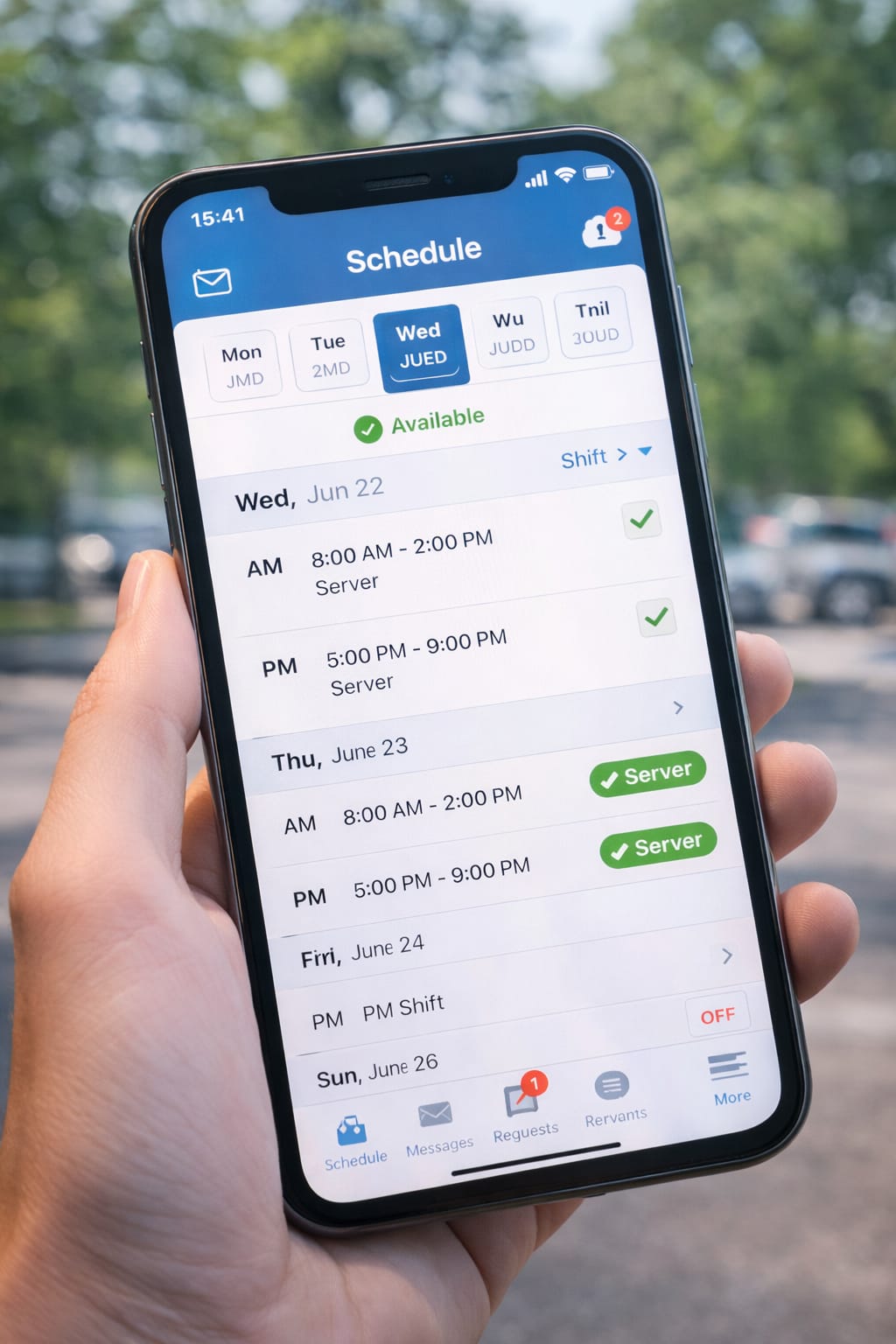
Mobile scheduling applications have become a core operational tool for many California employers. Platforms such as HotSchedules, 7shifts, When I Work, and Homebase allow employers to publish schedules quickly, manage availability, facilitate shift swaps, and respond to short-notice staffing changes. In industries with fluctuating demand and lean management structures, these tools can dramatically improve efficiency and reduce administrative friction.
Technological efficiency, however, does not displace California wage-and-hour compliance requirements. California law requires employers to implement scheduling technology in a manner that does not shift business costs onto employees or create unnecessary exposure under longstanding reimbursement and wage-and-hour statutes. The legal risk does not arise merely from deploying mobile scheduling applications. It arises when those systems are implemented in a way that effectively requires employees to rely exclusively on their personal mobile devices to perform essential job functions.
Mobile Convenience Versus Required Device Use
Labor Code section 2802, together with the Industrial Welfare Commission Wage Orders, requires employers to indemnify employees for all necessary expenditures incurred in direct consequence of performing their job duties. Labor Code section 2802, subdivision (a), provides:
An employer shall indemnify his or her employee for all necessary expenditures or losses incurred by the employee in direct consequence of the discharge of his or her duties, or of his or her obedience to the directions of the employer, even though unlawful, unless the employee, at the time of obeying the directions, believed them to be unlawful.
The purpose of this legal framework is straightforward: employers must not pass their operating expenses onto workers. Although the principle has existed for decades, its application increasingly intersects with evolving workplace technology.
When an employer’s scheduling system effectively requires employees to use their personal mobile phones to receive schedules, acknowledge shifts, submit availability, or respond to changes, particularly when employees are off-site, the employer risks converting optional convenience into required device use. That distinction is critical. Employers are on far firmer legal ground when employees can fully comply with scheduling requirements without using personal devices and choose mobile access solely for their own convenience. When mobile access becomes the only way to remain informed or responsive to employer scheduling directives, reimbursement obligations may arise regardless of the employer’s intent.
Lessons from Cochran v. Schwan’s
A useful illustration comes from Cochran v. Schwan’s Home Service, Inc., a 2014 California Court of Appeal decision that did not involve scheduling software, but squarely addressed the legal consequences of requiring employees to use personal cell phones for routine work communications. The case reveals the caution that must be exercised when employers deploy mobile-centric scheduling systems.
In Cochran, customer service managers alleged that their employer required them to use personal cell phones to make and receive work-related calls without reimbursement. The employer argued that reimbursement was unnecessary because many employees had unlimited calling plans and therefore incurred no additional out-of-pocket costs. It also pointed to variations in billing arrangements and plan structures as reasons why liability could not be resolved on a classwide basis.
The Court of Appeal rejected those arguments. It held that reimbursement under Labor Code section 2802 does not turn on whether an employee incurred incremental charges. If an employee is required to use a personal cell phone to perform job duties, the reimbursement owed by the employer is a reasonable percentage of the employee’s cell phone expense attributable to required business use. Focusing solely on out-of-pocket cost impact would improperly allow employers to shift operating expenses to employees, contrary to the statute’s purpose. The California Supreme Court declined review, leaving the decision intact as binding legal authority.
Established Law: Reimbursement Turns on Requirement, Not Cost Impact
The legal principle articulated in Cochran has been settled for more than a decade. When employees are required to use personal devices for work purposes, employers must reimburse a reasonable portion of the cell phone bill even if the employee experiences no additional monthly charges. The analysis centers on whether the use is required, not on whether the employee can absorb the cost without financial hardship.
That reasoning logically applies to mobile-only scheduling systems. If employees must monitor a scheduling app on their personal phones to determine whether they are required to work or to respond to changes, it becomes increasingly difficult to characterize personal phone use as entirely voluntary. The absence of a written policy mandate is not dispositive. Courts and enforcement agencies will focus on how the employer’s system operates in practice.
Short-Notice Schedule Changes and Operational Reality
Scheduling risk most often arises not from routine weekly postings, but from short-notice changes. Call-outs, fluctuating customer demand, and unexpected coverage needs are common realities. Employers understandably want fast and reliable methods of communication.
Compliance concerns emerge when the only practical method of notification is through a mobile app accessed on an employee’s personal device. If supervisors expect employees to receive and respond to off-site notifications in real time, those operational expectations may undermine any claim that mobile use is optional. Written policies to the contrary are undermined when they are inconsistent with day-to-day practice.
Designing Scheduling Systems That Reduce Legal Risk
Compliance does not require employers to abandon mobile scheduling applications altogether, but instead to structure them as one option among several available to employees. Employers can substantially reduce exposure by maintaining functional, non-mobile alternatives that allow employees to comply with scheduling requirements without using personal devices.
Common alternatives include posting schedules at the worksite, permitting availability and time-off requests to be submitted in person or on paper, and providing a sufficient number of employer-owned tablets or kiosks where employees can access scheduling systems on site. These measures help preserve the employer’s defense that personal device use is a matter of convenience rather than necessity.
Written policies should reinforce this structure by clearly stating that personal mobile device use for scheduling is optional, identifying available alternatives, and confirming that employees will not be disciplined or disadvantaged for declining to use personal devices. Supervisor training is essential, because inconsistent front-line enforcement is often what converts theoretical compliance into real-world liability.
Why Itemized Reimbursements Are the Safer Answer
In some roles, business use by employees of their personal devices is genuinely required. Managers, on-call employees, and positions requiring off-site responsiveness may reasonably need to receive and respond to work communications away from the workplace. In those circumstances, the imperative is to provide a reasonable reimbursement consistent with Labor Code section 2802.
When recurring reimbursements are paid with regular wages, separately itemizing the reimbursements on paystubs is critical from a risk-management perspective. Clear itemization is a best practice, helps prove reimbursement compliance, and reduces pay-statement disputes. Lumping reimbursement into total wages with no description creates evidentiary problems and invites Labor Commissioner penalties, individual wage-and-hour claims, class action lawsuits, and representative actions under the Labor Code Private Attorneys General Act (PAGA).
Determining the Reimbursement Amount
As held in Cochran v. Schwan’s Home Service, Inc., when employees are required to use their personal cell phones for work purposes, the employer must reimburse a reasonable percentage of the employee’s cell phone expense attributable to required business use. The obligation does not turn on whether the employee incurred incremental charges, but on whether the personal device use was required. That said, determining what portion of each employee’s individual voice and data plan is attributable to business versus personal use can be administratively burdensome, particularly in a large or geographically dispersed workforce.
The California Supreme Court addressed this practical challenge in Gattuso v. Harte-Hanks Shoppers, Inc., a 2007 decision involving required business use of employees’ personal automobiles. Although Gattuso arose in the mileage and vehicle-expense context, its analysis of Labor Code section 2802 is logically applicable to other categories of required employee expenditures, including required cell phone use. The Court recognized that section 2802 does not mandate a single reimbursement methodology and acknowledged multiple legally compliant approaches, including both an “actual expense” method and a “lump-sum” method.
Under the actual expense method, employees are required to maintain detailed records of expenses incurred and submit those records to the employer for reimbursement. The employer must then determine which expenses were necessarily incurred in the discharge of the employee’s job duties and reimburse those amounts. While this method can be precise, it often imposes significant administrative and recordkeeping burdens on both employees and employers.
By contrast, the lump-sum method does not require employees to keep detailed records or submit individualized expense information. Instead, the employer pays a fixed reimbursement amount derived from a reasonable estimate of the expenses employees typically incur in performing their duties, based on the employer’s general understanding of the nature, frequency, and extent of required business use. In Gattuso, Harte-Hanks utilized a lump-sum reimbursement model, which the plaintiffs argued violated Labor Code section 2802 because it was not directly correlated to each employee’s actual expenses.
The Supreme Court rejected that argument. It held that Labor Code section 2802 does not require a strictly “correlated” reimbursement method tied dollar-for-dollar to documented expenses. Rather, the statute permits employers to use alternative reimbursement methods, including lump-sum payments or enhanced compensation structures, so long as the chosen method fully reimburses employees for all actual expenses necessarily incurred in the discharge of their employment duties. The critical inquiry is not the method itself, but whether employees are, in fact, fully indemnified as the statute requires.
The Business Case for Prospective Compliance
Reimbursement disputes frequently involve what are, at their core, modest dollar amounts on a per-employee basis, but those sums become magnified exponentially once litigation begins. Defense costs, penalties multiplied for every employee and every pay period, and attorneys’ fees often far exceed the cost of implementing compliant systems on the front end.
From a business perspective, the calculus is straightforward. The cost of prospective compliance—maintaining alternative access methods, enforcing clear policies, training supervisors, and reimbursing required device use—is invariably lower than the cost of defending wage-and-hour litigation or administrative enforcement actions.
Mobile scheduling applications are here to stay, and they remain invaluable efficiency tools. Employers that deploy them thoughtfully, with an understanding of settled California law, can realize those efficiency gains without creating avoidable legal risk.