
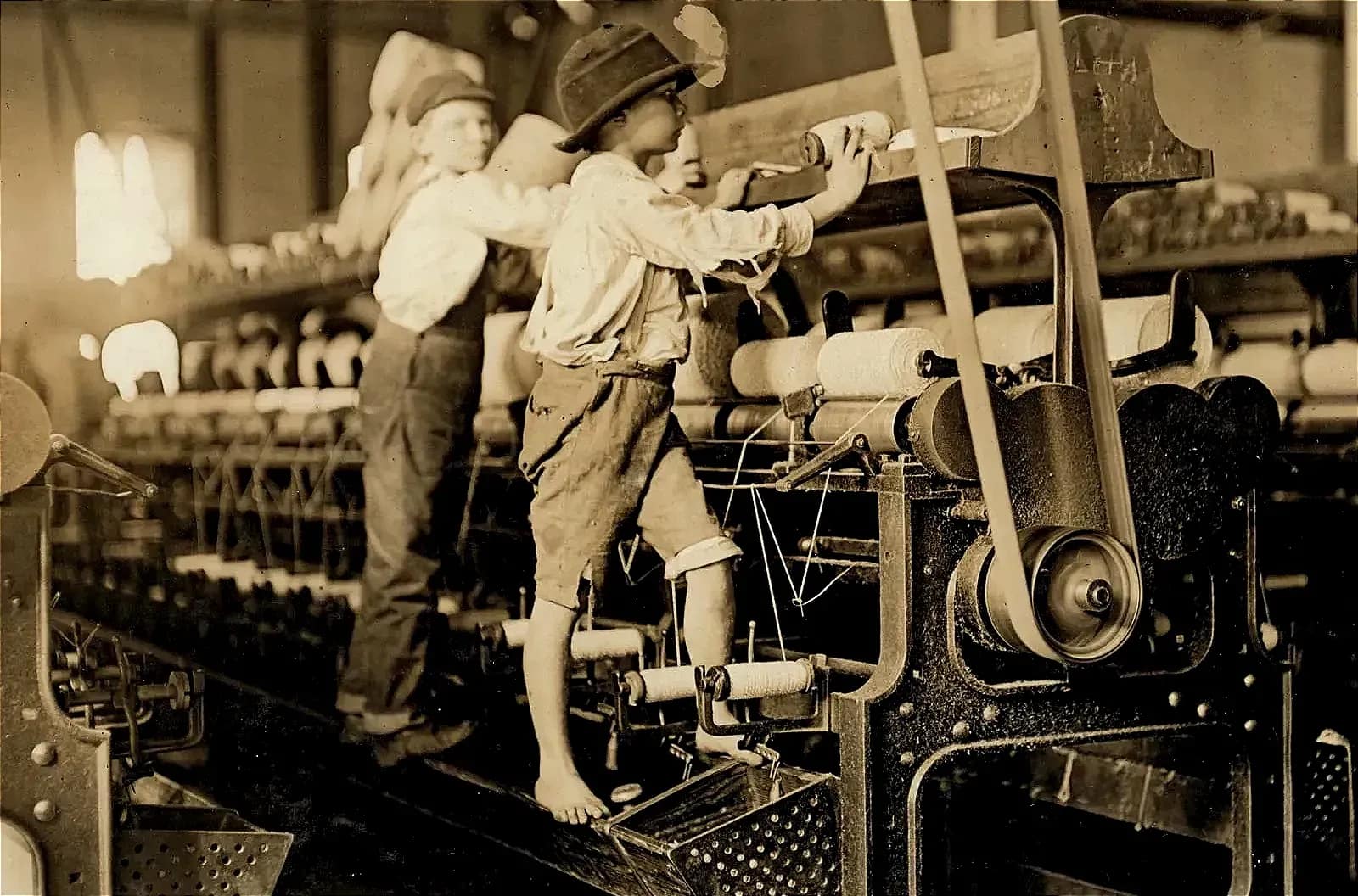

Children Working at Bibb Mill No. 1 (1909)
The photograph was taken in January 1909 at Bibb Mill No. 1 in Macon, Georgia. It shows anonymous children working on a spinning frame in a cotton mill. The machines are large. The space is tight. The children are small enough that they must climb onto the machinery to reach the threads and bobbins that break during operation.
Bibb Mill No. 1 was a historic textile mill located on Coliseum Drive in East Macon, owned and operated by the Bibb Manufacturing Company. Founded in Macon in 1876, the company was part of a wave of southern industrialization that reshaped both work and daily life at the turn of the twentieth century.
Like many textile operations of the period, Bibb Manufacturing functioned within a company-town model. The mill was the center of a tightly organized community in which the company provided housing, access to stores, schools, and other basic services for its workers and their families. Employment, housing, and daily necessities were closely linked, leaving families with limited alternatives and little bargaining power. This structure was common across industrial America at the time, particularly in textile regions, where employers exercised broad control over both working conditions and the lives of those who depended on mill wages.
The photographer was Lewis Wickes Hine, working as an investigative photographer for the National Child Labor Committee. His assignment was direct. He was sent to document working conditions that most Americans did not see and, in many cases, preferred not to acknowledge. The photograph was not staged. It records what was present in the mill on an ordinary working day.
At the time, child labor was common in textile mills throughout the southern United States. Children worked long hours, often barefoot, surrounded by moving machinery and airborne cotton dust. Many were employed because their size made them useful for tasks that adults could not perform easily, such as crawling under spinning frames to mend broken threads or replace empty bobbins while the machines continued to run.
The economic reality behind this labor is difficult to separate from the image itself. In southern cotton mills around 1909, child laborers typically earned between 15 and 40 cents for a full day’s work, depending on age, task, and hours, with younger children often paid less than older siblings or adults. These figures appear consistently in National Child Labor Committee reports and in Lewis Hine’s contemporaneous field notes. Adjusted for inflation using Bureau of Labor Statistics Consumer Price Index data, 15 cents in 1909 is roughly equivalent to about $5 today, and 40 cents to approximately $13. There was no minimum wage, no overtime protection, and no legal limit on hours.
There were few legal protections. Federal child labor laws did not yet exist in any meaningful form. States regulated unevenly, and enforcement was limited. Families depended on the wages, small as they were. Mill owners relied on a workforce that could be paid less and replaced easily. The system functioned because it was legal, accepted, and largely unseen by those outside it.
Hine’s photographs were intended to change that. He recorded names, ages, hours worked, and conditions, pairing images with detailed notes. The goal was not to create art, but to marshal evidence. These photographs were used in reports, lectures, and public campaigns to show that industrial progress carried costs that were being borne by children.
The image shows two children at work, focused and steady, doing what was expected of them. It does not show injury, but the risk is present. It does not show exhaustion, but the hours were long. The power of the photograph lies in its immortalization of ordinary life for a working child in a southern mill town at the turn of the 20th century.
Change came slowly. Early federal efforts to regulate child labor were struck down by the Supreme Court in the 1910s and 1920s. In Hammer v. Dagenhart (1918), the Court considered the constitutionality of the Keating–Owen Child Labor Act of 1916. That statute prohibited the interstate shipment of goods produced in factories or mines that employed children below specified ages or for excessive hours. The case was brought by the father of two boys who worked in a North Carolina cotton mill, challenging the law on the ground that it interfered with local manufacturing and parental authority.
The Supreme Court agreed. By a 5–4 vote, the Court held that Congress lacked authority under the Commerce Clause to regulate the conditions of production within states. The majority drew a sharp distinction between commerce, which Congress could regulate, and manufacturing, which it characterized as a purely local activity occurring before interstate commerce began. Because the Act targeted the conditions under which goods were made, rather than the movement of goods themselves, the Court concluded that it exceeded federal power. The decision left regulation of child labor almost entirely to the states, many of which had weak or poorly enforced laws.
Congress responded by attempting a different approach. In Bailey v. Drexel Furniture Co. (1922), often referred to as the Child Labor Tax Case, Congress imposed a substantial federal tax on companies that employed child labor. The government argued that the law was a valid exercise of Congress’s taxing power rather than a direct regulation of labor.
The Court again disagreed. It held that the tax was not a genuine revenue measure but a penalty designed to coerce compliance with federal labor standards. Because the tax applied only to employers who violated child labor restrictions and was structured to discourage behavior rather than raise revenue, the Court concluded that Congress was improperly using its taxing power to accomplish what it could not do directly under the Commerce Clause. The law was therefore unconstitutional.
Taken together, Hammer and Bailey illustrate the judicial environment, hostile to federal interventionism is state labor practices, in which Lewis Hine’s photograph was taken. Even as evidence of child labor circulated widely, the Supreme Court’s prevailing interpretation of limited federal power prevented Congress from establishing nationwide labor protections. It was not until the constitutional shift of the late 1930s, culminating in the Fair Labor Standards Act of 1938, and its later judicial approval in United States v. Darby (1941), that durable federal child labor protections became constitutionally permissible. By then, images like Hine’s had been circulating for decades, informing public understanding and political discourse.
Today, the photograph remains an indelible record of child work as it was practiced in plain sight. It documents children performing industrial labor and reminds us that modern child labor protections were not always present. They were built, piece by piece, in response to conditions that had first to be seen.
We feature this photograph as part of that historical record. It shows how work once depended on children’s labor and how legal standards evolved through changing public sentiment informed by images like this, political will, and legal advocacy. Workforce technologies have changed, and the laws have evolved, but the lessons of history must not be forgotten.