
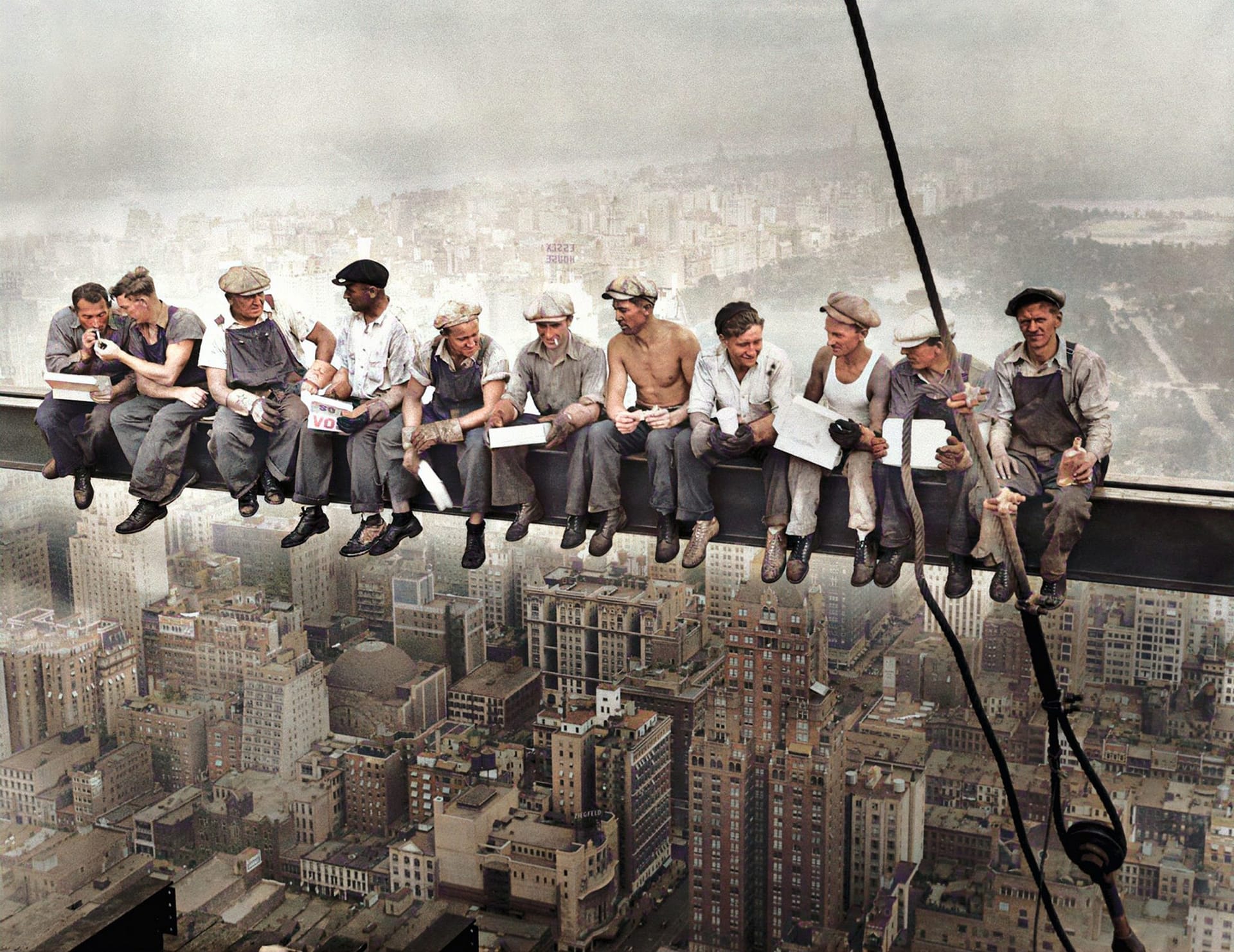

Lunch Atop a Skyscraper (1932)
The photograph was taken on September 20, 1932, at a time when work in America had become just as precarious, and nearly three years before enactment of the National Labor Relations Act establishing workers’ protected collective bargaining rights. Eleven anonymous ironworkers sit on a steel beam suspended 850 feet above Manhattan during the construction of the RCA Building at Rockefeller Center. The city stretches below them, distant and indifferent as they eat lunch and take a break.
The height is real. The men are real. The work is real. But the image was staged. It was made for publicity and published in the New York Herald-Tribune on October 2, 1932. The photo was meant to reassure the public that progress continued despite the Great Depression. In 1932, the estimated U.S. unemployment rate was about 23.6 percent of the labor force, reflecting the bleak economic conditions that soon led to President Franklin D. Roosevelt’s New Deal. The placement of the men was curated, but the labor they symbolized was authentic. These were working ironworkers, hired to raise steel in a city that kept building even as breadlines grew longer at street level.
In 1932, construction was governed less by regulation than by rugged necessity. There were no federal safety laws comparable to those that exist today. Harnesses and guardrails were uncommon. Falling was a known risk, and injury or death was not an abstraction but a possibility that followed workers onto the beam each morning. The photograph shows this plainly, without comment or instruction.
In the five years following this snapshot, New Deal legislation affecting workers included the Social Security Act of 1935, which established old-age and unemployment benefits, and the Fair Labor Standards Act of 1938, which introduced a federal minimum wage, overtime pay requirements, and child labor protections. It would be another 38 years before the federal Occupational Safety and Health Act (OSHA) was enacted under President Nixon.
The names of these men were never recorded, and no employment document has been conclusively tied to the photograph. Over time, people have tried to assign identities where the record is silent. At the time, New York construction relied heavily on immigrant labor, and ironworkers of this period often came from Irish, Italian, Scandinavian, German, and Eastern European communities. Mohawk ironworkers from Kahnawà:ke in Canada were also well established in high-steel work in New York.
The 2012 documentary Men at Lunch set out to explore those unanswered questions. It traced family histories, reviewed archives, and examined the economic and cultural forces that shaped the workforce. The film did not identify the men with certainty, but it placed them within a city built by newcomers who worked where work was offered, often at great risk and for modest pay.
Authorship of the photograph remains uncertain as well. Charles C. Ebbets is most often credited, but multiple photographers were present at Rockefeller Center that day, and no surviving record conclusively establishes who took the image. The Library of Congress reflects this uncertainty, listing Ebbets as the likely photographer while noting the absence of definitive proof.
The men sit close together on the beam. They share food and space. The posture suggests ease, but it is also practical. At that height, there is nowhere else to go. The photograph does not tell us what the men believed about their work or their future. It shows only that they were there, that they were employed, and that the building rose because they stayed on the beam.
Modern colorizations of the image, such as the one depicted here and displayed in our law offices, make it feel closer to the present, but they do not add new facts. The photograph remains what it has always been: an iconic record of labor during an economic crisis, of men whose work was necessary and whose identities were considered secondary to the structures they built.
Seen this way, Lunch Atop a Skyscraper is not an abstraction or a metaphor. It is a moment in the long history of American work, captured without names and without commentary, showing how cities are raised by people who rarely appear in the finished skyline.
We feature this photograph not only for nostalgia, but also because it remains a vivid reminder of the dignity of work and the real costs borne by those whose labor built our country’s physical and economic foundations. The American economy continues to evolve, moving from heavy industry to technology, information, and digital services; yet the central role of workers has not diminished. The forms of labor may change, but the dependence of progress and our collective future on human effort, skill, and sacrifice remains constant.